
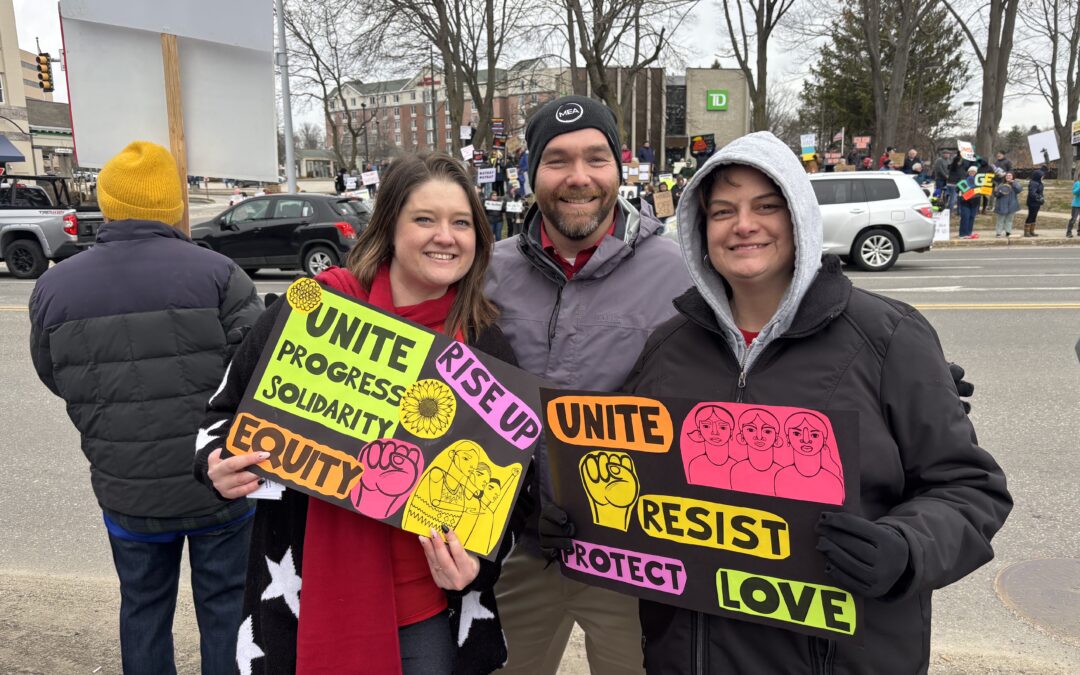
In March, I stood with parents, students, school committee members, and educators standing in front of Deering High, Rowe Elementary, and Presumpscot Schools during their locally organized “walk-ins” in support of public schools. Weeks later, I joined educators and community members from Lewiston and Auburn on Longley Bridge to raise our voices against federal policies that put public education funding at risk. Then on May Day, I joined colleagues from National Education Association (NEA), Service Employees International Union (SEIU), and American Federation of Labor and Congress of Industrial Organizations (AFL-CIO) in Lafayette Square in Washington D.C. to stand in support of collective bargaining and organized labor rights.
For over 15 years, I’ve taught students in public schools and evening adult education programs, helping them understand the ongoing fight for democracy, equality, and human rights. From the labor movement to women’s suffrage and the civil rights movements, history shows how people have organized together to drive meaningful change.
These recent, peaceful demonstrations in support of public schools, students, and labor are inspiring; they’re only the beginning. To create lasting change, we must turn these public displays of solidarity into personal—and sometimes uncomfortable—conversations with friends, family, and neighbors. That’s how real change takes root.
While we have seen thousands of supporters show up for demonstrations across the state, in many communities, protecting public education funding happens at the ballot box. These large crowds do little good for when local elections gather embarrassingly low turnouts and instead give disproportionate influence on organized opposition and weakens the voice of the majority of Maine citizens who rely on the public services like our schools.
In MSAD 58 (Avon, Kingfield, Philips, and Strong), fewer than 400 voters across all four towns rejected the school budget. In RSU 15 (Gray/New Gloucester), the budget failed by just 19 votes. In RSU 21 (Arundel, Kennebunk, Kennebunkport), only 25% of voters showed up to vote on the school budget—it was defeated by only 361 votes. Across the board we saw low voter turnout— Lewiston’s budget passed by only 14 votes with a 7% turnout, and in South Portland it was only 12%.
When budgets fail, our students are impacted. School committees and administrators are forced to make tough decisions regarding student programing, staffing, and facility needs— often delaying needed improvements, cutting services, and reducing staff. This places additional burdens upon our educators and limits learning opportunities for students.
The status quo has been disrupted. Federal, State, and local funding are in flux, and programs that students and schools have long relied on, are now uncertain. However, all politics is local, and our communities still want high-quality, safe schools, that offer diverse and rigorous learning opportunities.
One way or the other, we will adapt. We will continue to find our collective strength, rowing together as in the same boat, building organizing power, and forging common ground with allies. As I write, I’m working with labor partners across the state, union members who are also parents and community members, committed to supporting our schools. Like us, they understand that strong schools build strong communities, and that those working against public education often oppose labor rights as well. We accomplish more when we work not only for our individual interests, but for the betterment of all.
As you slide into summer routines, I hope you will enjoy some much-needed down time, but I also ask you to join me in sharing the successes of our educational programs, the amazing work you and your colleagues do, and why we are essential in making Maine the way life should be.