
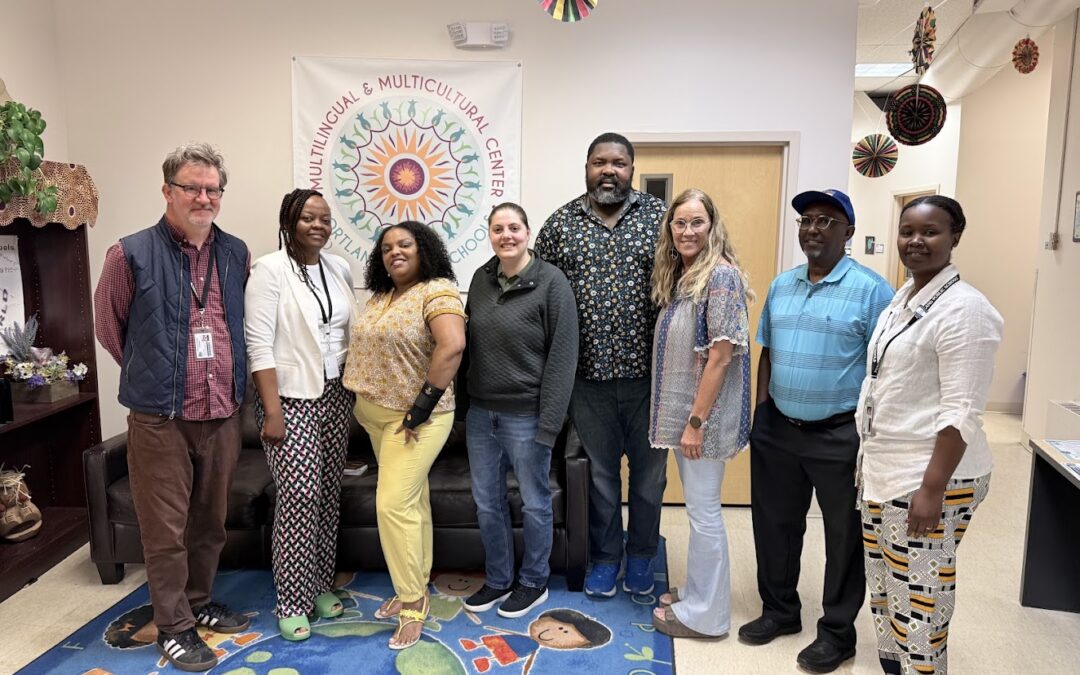
In the midst of bargaining their first contract after joining the Portland Education Association in January, staff at the Multilingual Center explain why union membership is vital to protecting services for the 40% of Portland Public Schools students and families who rely on the center.
Coming to the Multilingual & Multicultural Center at Portland Public Schools (PPS) from a range of backgrounds—former teachers, education support professionals, nonprofit workers, and even a former dentist and nurse— Multilingual Center staff play a vital role to the students and families in Maine’s most diverse school district.
After unanimously voting to join the Portland Education Association (PEA) in January and gaining official recognition in February, the 14-member bargaining unit is now negotiating their first contract.
At the heart of their organizing effort is preserving their vital department so that they can continue to serve multilingual families at PPS. Their bargaining priorities include job security, adding steps for meaningful raises, ensuring that Multilingual Center staff receive credit for professional development, and compensation for working longer hours and more contracted days.
→“WHAT WOULD THE DISTRICT DO WITHOUT US?”
The Multilingual Center provides critical support, especially for newcomer families. Staff help families understand class schedules, sports, extracurricular activities, enrollment, and how the school system works.
“Our job is to interpret [during] IEP meetings, parent-teacher conferences, and new student intakes,” says Todd Chretien, a Spanish interpreter for PPS. “We also help multilingual families feel comfortable communicating with teachers and administrators. A lot of our work is building relationships with families and helping educators who may not speak their language do the same.”
That work goes far beyond interpreting. Multilingual Center staff are present at most community events held by PPS.
They help families complete school forms and college applications and connect them with social services, outreach programs, and engagement opportunities. At any given moment, staff may be on the phone helping families navigate urgent challenges.
Many school districts rely on contracted interpreting services. Nana Kanjinga, who works with French- and Lingala-speaking families, says those services are often more expensive and lack the depth of support provided by in-house staff. “Outside interpreters don’t build the same relationships or provide the same community connection that we do,” Kanjinga says.
Betsy Paz-Gyimesi, who works alongside Chretien with Spanish-speaking families, describes the role as that of a cultural broker. “Parents don’t always understand why a teacher responds a certain way or how to use school resources,” Paz-Gyimesi says. “We collaborate with social workers, teachers, and staff. We are a conduit that helps everyone connect.”
According to Kanjinga, this support often extends beyond school walls. “If a family needs mental health support, counseling, or a case manager, we help them find that,” Kanjinga says. “Whatever helps the family and student be stable and able to come to school, that’s what we do.”
That level of trust does not end when families move away. “Families often reach back out,” Paz-Gyimesi says. “They feel lost without the support they had here, and we still help when we can because of those relationships.”
Kanjinga agrees. “Families will call months or even years later asking for help understanding a document or enrolling a child,” she says. “Online systems are a big barrier for many families.”
Colby Senior, a family and community specialist in the Multilingual Center, helps organize family and community events. These include engagement opportunities with the School Board and family engagement events for fifth graders transitioning to middle school—such as step-up days organized by the school, where multilingual staff help support students as they learn to manage lockers and navigate multiple teachers.
Senior says many districts rely on just one family liaison, but PPS’s centralized model offers something more. “It’s a vital service,” she emphasizes. “Districts across Southern Maine, and the state, are experiencing similar growth in multilingual learners, and they look to PPS as a model.”
For Chretien, that ongoing support highlights why the district’s commitment matters. “PPS’s commitment to multilingual communities has grown over the years, and we want to protect that,” he says. “When students and families can’t communicate with educators, it affects everyone’s learning environment.”
→MAINTAINING THE DISTRICT’S COMMITMENT TO EQUITY
Paz-Gyimesi, who has worked at the Multilingual Center for more than a decade, says organizing with the union had been discussed for years, but a major catalyst for organizing, comes down to the threat of further position cuts and the uncertainty that staff in the Multilingual Center face due to the political climate.
Last year, Chretien says, three interpreter positions were eliminated. “Without representation, we felt we would be vulnerable again during budget shortfalls. Job protection was a key motivation for our staff.”
For Kanjinga, organizing was also about advocacy for families. “Being here allows us to be a voice for families,” Kanjinga says. “We know the district, the language, and the system. That makes a real difference when we’re interpreting and advocating.”
Paz-Gyimesi adds that the current political climate, particularly around immigration enforcement, makes collective action more important than ever. “Given the direction things are going, unions matter,” she says. “They give workers a way to be heard.”
Chretien adds that equity is also a workplace issue. “Our bargaining unit is mostly women and people of color,” Chretien says. “It’s about whether the district values interpreters as professionals and compensates them fairly for work that goes far beyond interpreting.”
→BUILDING SOLIDARITY ACROSS BARGAINING UNITS
For staff in the Multilingual Center, bargaining their first contract is not only about working conditions and job security. It is also about creating a lasting legacy for their department and strengthening relationships with other PEA members and PPS staff.
“This contract is for those who come after us,” Senior says. “We’ve built a supportive, collaborative culture at the Multicultural Center, and we want to protect that for future staff. We want anyone hired after us to have the same support that we give one another now.”
For Chretien, being part of the same union as other PPS employees creates new opportunities for connection. “Being in the same union as teachers, education technicians, and other school staff helps build understanding,” Chretien says. “It creates another way to improve communication, not just with families, but with each other.”
→Supporting Multilingual Learners Course
Explore second language acquisition and discover instructional strategies to support multilingual learners’ academic and emotional growth. Sign up at maineea.learnupon.com