
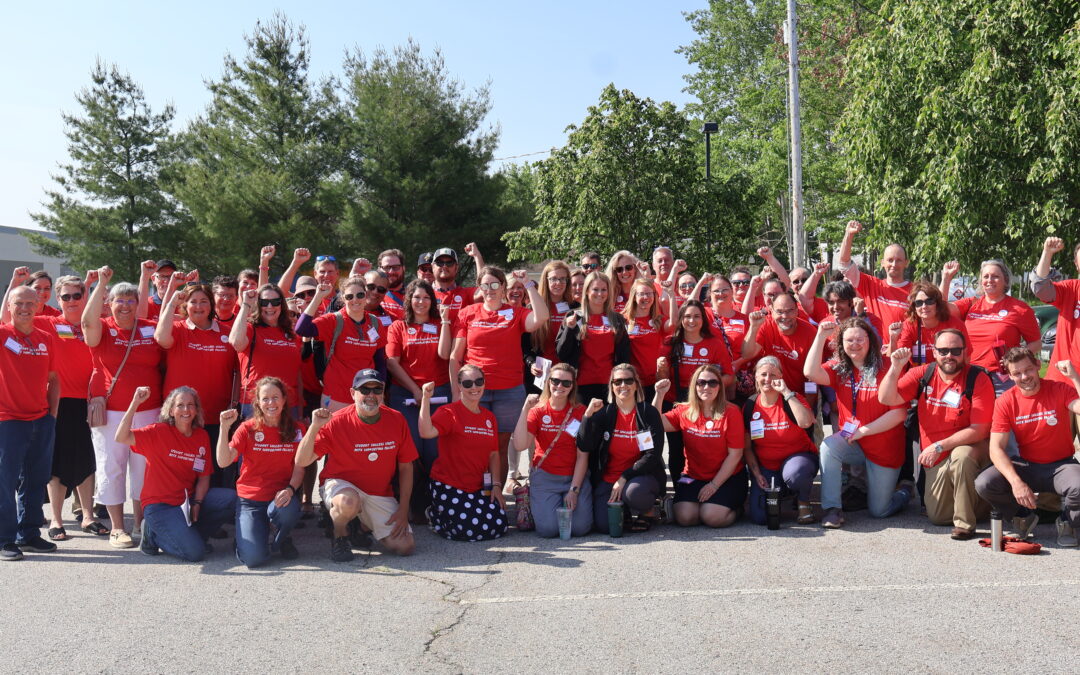
Bangor— Wearing red shirts printed with the message “Student Success Starts with Supporting Faculty,” members of the Community College Faculty Association (CCFA) gathered Wednesday, June 11th to make one point clear: when faculty are supported, students thrive.
This powerful display of unity took place during the Maine Community College System’s annual Professional Development Day, Dirigo Day, where more than 70 faculty members gathered to advocate for the resources and respect, they say are essential to serving their students.
Since 2020, enrollment at Maine’s seven community colleges has surged, partly due to the Free Community College Program passed by the Maine Legislature in 2021. This fall, enrollment exceeded 20,000 students. However, faculty numbers have remained unchanged since enrollment hit its lowest point of 15,000. The growing discrepancy has put increasing pressure on educators, who now face additional responsibilities and larger course loads with limited resources.
Shari Ward, faculty member at Northern Maine Community College (NMCC) and President of CCFA, described how this imbalance affects students. “We are being stretched thin. We are faced with taking overloads,” she said. “When enrollment was down, [the administration] cut faculty positions, but now that enrollment is at an all-time high, faculty have not been hired back. That has a direct impact on our students— I am losing time for the one-to-one interaction with my students that make the Community College experience special.”
Systemwide wages have not kept up with inflation—putting additional pressure on faculty, who are often forced to take on extra roles to make ends meet. According to the CCFA, 91% of faculty report seeking extra work to make ends meet, and 56% of faculty have considered leaving the system in the last three years due to stagnant wages that have failed to keep pace with inflation. Faculty have experienced a real wage decrease since 2020, with the sharpest drop—3.42%—occurring in 2022.
An electrical instructor from Kennebec Community College (KVCC) shared the financial trade-off many faculty face. “The trades are important, but when we ask people to come here [the community college system] to teach, we’re asking them to make a big sacrifice. Many of us could earn more working directly in the trades. I do this because I want to give back and help the trades grow—but we lose credibility with our students when we’re making half of what they earn right out of school.”
Jessica Gleason, Physical Therapy Clinical Education Coordinator at KVCC, took a $20,000 pay cut to teach at the community college. “Ten years later, with a master’s degree, I send students out [to their jobs] making $10 more an hour than I earn with a decade of experience working at the community college,” she says—a reality reflected in statewide data showing Maine faculty salaries lag behind both inflation and regional averages.
Community college faculty bring a rare combination of expertise: they are not only masters of their disciplines, trades, and professions, but also skilled educators who understand how to teach a diverse and dynamic student population. That teaching expertise takes years to develop—and once it’s lost, it is not easily replaced.
“We are here today to send a strong message so that we can recruit and retain the best faculty in the state so that we can serve our students the best way that we can,” said Mike Tardiff, President of KVCC’s chapter of CCFA.
Faculty say the issue is not just about compensation—it’s about student outcomes. “When you invest in faculty, you invest in committed, seasoned faculty members that support student success,” Gleason said.
Average Faculty Salary at a Public 2-Year College:
Average faculty salaries at public two-year colleges in Maine rank 37th in the nation. Here’s how Maine stacks up against nearby states and the national average.
Connecticut: $93,555
National Average Public 2-year: $81,344
New Hampshire: $73,561
Massachusetts: $71,042
Rhode Island: $67,727
Maine: $65,987