
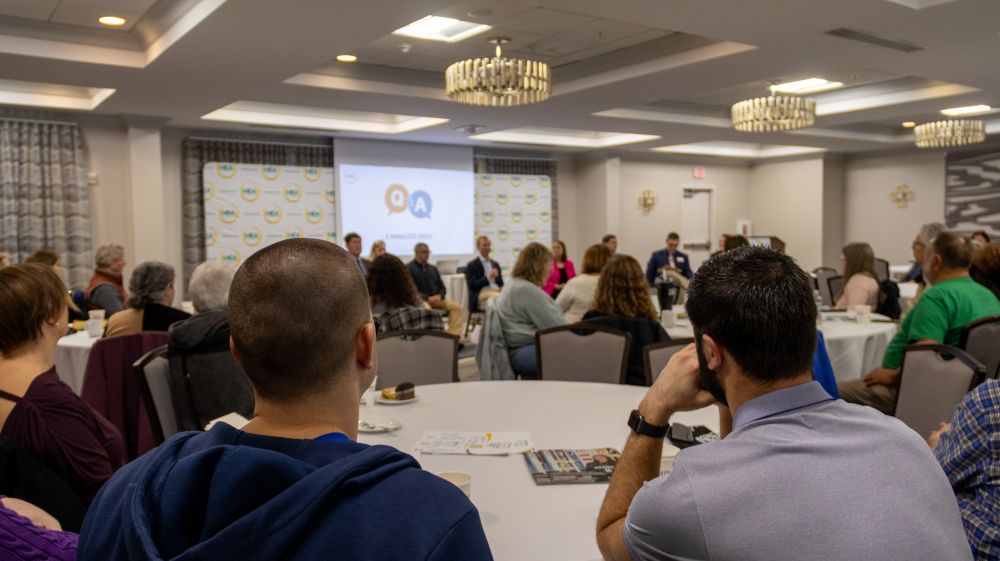
This spring, the Maine Education Association is hosting its first ever primary endorsement process for the next governor of Maine. As part of that process, candidates were invited to participate in MEA’s gubernatorial forum, Coffee with the Candidates. MEA invited all Republican and Democratic candidates for governor to take part.
Over one hundred MEA members filed into the room in April to hear from candidates which included Democrats Troy Jackson, former Senate president; Dr. Nirav Shah, former director of the Maine Center for Disease Control and Prevention; Businessman Angus King III; and Shenna Bellows, Maine secretary of state, Republican Senator Jim Libby joined us for the event, but has since dropped out from the race. Hannah Pingree, former speaker of the Maine House of Representatives, was unable to attend because of a prior commitment and sent Representative Michael Brennan to speak on her behalf.
All of the candidates shared their passion for public education, including the educators who made a difference in their lives and helped them get where they are today. Check out the video below to hear from each of the candidates who were there, and takeaways from the event.
MEA members had the opportunity to submit questions they hoped to learn more about from candidates and to speak with candidates before and after the event. Below are some of those questions and the candidates’ responses. Please note that responses were edited for clarity and brevity.
What specific investments will you prioritize in public education funding to address teacher shortages, student mental health needs, and equitable opportunities for all students?
Bellows: We need to invest in teacher pay, teacher supports, teacher training, workforce development, school infrastructure, and school‑based health centers in every school. That includes mental health counselors, school psychologists, and social workers in every school.
Teacher pay must start at $50,000 as a minimum, and in my first budget, I will set that baseline and attach a cost‑of‑living adjustment so we do not keep falling behind. We also need mentorship stipends of $10,000 a year for experienced teachers who mentor student teachers in the classroom.
Student teachers should be paid. We should cover transportation costs and provide a living stipend so student teaching can be treated as full‑time work. Teachers also should not be paying for classroom supplies out of pocket. Schools need dedicated classroom budgets.
Our school buildings are crumbling. In my first year, I will introduce an education bond to fix our schools. We are failing our children when facilities are unsafe or outdated.
I will pay for these investments through tax fairness. I support a millionaire’s tax, a moratorium on property taxes for Maine residents funded by higher taxes on non‑residents, and a revised funding formula so the state pays more than its fair share of education costs.
Jackson: I believe we should invest more in education, even though we are technically at 55 percent [in state funding toward public education]. Two sessions ago, we fought to get teacher salaries to $50,000, but we are still far behind. Waiting three years to reach $50,000 in this economy is not enough. That is not how we attract people to the profession.
There is a teacher shortage across the state, and we need to make teaching more competitive. When we have revenue, raising teacher pay needs to be a priority. The Legislature passed a millionaire’s tax, and I would go back and revisit past tax cuts, including the LePage tax cuts, and bring that revenue back into the state. That money should go directly into education to help attract and retain teachers.
I have always believed in supporting educators. A few years ago, a Republican legislator introduced an amendment to increase funding for retired teachers. Some Democrats were hesitant because of who introduced it, but I supported it because it was the right thing to do. I do not care who sponsors a bill if it helps educators and students.
King: Educators do the hard work of caring for our children and preparing them for the future. Students spend a lot of time outside the classroom dealing with challenges like nutrition, truancy, and behavior, and that often pulls teachers away from teaching. We need to support educators in addressing those needs.
I support increasing teacher pay and adding a cost‑of‑living adjustment so we do not fall behind year after year. We should pay student teachers, expand training opportunities, and create clearer career pathways so teachers can advance and earn more without simply taking on more work.
We also need to reduce the certification pain and brain damage that exists right now. There are some solutions that have been proposed to fix that. Strong onboarding and support are critical, especially in the first two years, when we lose too many teachers from the profession.
In terms of mental health, that is a growing challenge. Maine has one of the highest rates of students with IEPs in the country, in part because we do a good job with early detection. I think what is really important to recognize that CDS has been a failure. We fell way behind in outcomes for our kids. We need to keep strengthening early detection and ensure schools are supported as systems transition and improve services for students.
Shah: The education infrastructure in the state of Maine needs a complete rethink, and as governor, I will support that work. We need to start by supporting teachers and the next generation of educators.
A $50,000 starting salary is a step forward, but it is not enough. Each year, 1,300 to 1,400 teachers retire or leave the classroom, while Maine only trains about 400 new teachers. Many of them do not stay in the state. Even at $50,000, Maine’s starting salary is still lower than Massachusetts, so we have a long way to go to rebuild the pipeline.
But it doesn’t just end with higher salaries. Teachers are facing more challenging classrooms than ever. Speaking with a teacher in Lewiston earlier. We were talking about how in Lewiston, they’re cutting social services and social workers from their budget at a time when we know students are struggling.
Many districts are cutting social services at the same time students need more support. I recently visited a school in Dover‑Foxcroft and saw how important student well‑being is to a healthy learning environment. Thanks to the MEA, I had the privilege of spending a day, my day in the school, up in Santa SeDaMoCha in Dover Foxcroft. The priorities that the school there was focused on to keep students’ well being from the front and center. We need to do a lot more to improve the behavioral health of our students. It’s better not just for them. It’s better for other students, and it’s better for you all as professionals.
The last piece that really keeps me up, that night is the last round of infrastructure funding, there were two schools in Maine that got funded, and both of them had burned down. We need additional funding, and it can’t just be when your school has burned down.
Could you share with us what your thoughts are on the changes made to Maine Public Employees retirement cost-of-living under the 2011 administration of Gov. Paul LePage. If you become governor, what would you do to help MEPERS recipients who are in retirement without a full COLA?
Bellows: I think it was wrong. I was not there at the time. I was head of the ACLU of Maine and was partnering with teachers on civil liberties and First Amendment education. But it was wrong. As a state senator, I represented many retirees from MSCA, and I worked very hard to pass legislation to fix what was done. We did not get it passed then, but as governor, I will make sure we get it done. We need to scrap the cap. Retirees deserve a cost‑of‑living adjustment on the full amount of their earnings, period.
One reason I feel so strongly about this is my own experience. When I was a kid, we did not call it food insecurity. When my dad was doing well, we ate well. When times were tough, we ate big bowls of oatmeal and peanut butter. When I served in the state Senate, I was deeply committed to access to food for everyone. Troy and I worked together on that. It was my bill that brought breakfast after the bell so kids could start the school day not hungry.
When I knocked on 10,075 doors in my district, a district that voted for Trump and also voted for me twice, I heard from retirees who were skipping meals and going hungry. I also championed legislation for Meals on Wheels, but quite frankly, if we paid retirees enough, they would not have to depend on a food pantry.
Jackson: My view is that it was a big scam, and I was there. That was Bruce Poliquin’s work, showing how income tax cuts could be given to the wealthiest people in the state of Maine on the backs of retirees. It is the same thing we see now [in Washington]. Income tax cuts benefit the wealthiest people in this country on the backs of working‑class people. That is what happens every time.
As Senate president, people criticized me for returning to majority budgets. The reason we did that was because Republicans once again demanded income tax cuts. I would not do income tax cuts, and I would not cut reproductive rights. Those were the reasons we returned to majority budgets. I refused to do those two things.
In 2011, the goal was to take as much money as possible from retirees in order to give $400 million to wealthy people in the state. I was one of five Senate Democrats who did not vote for that budget. We held it up one night, but my leadership came back the next day and gave it up for nothing. I would not have supported it anyway, because I will never support income tax cuts on the backs of working‑class people.
I have a record of that, and I will never do it. If I am elected, I will restore the income tax cuts enacted under Governor LePage and try to put as much money as possible back into the retirement system.
King: Paul LePage likes to brag that he was Trump before Trump. On this issue, he is 100% right. He gave tax cuts to the wealthiest people by taking things away from working people. That is exactly what we are seeing now with Donald Trump. Tax cuts for billionaires, while health care, food assistance, and heating assistance are taken away from working people.
That is something the next governor is going to have to fight tooth and nail, whether by banding together with other blue‑state governors, working with attorneys general, pushing back directly, or sometimes figuring out how to work around it. This is a challenge we are going to continue to face for the next few years. Paul LePage did the wrong thing, and I do think fixing the COLA cap is a good idea.
One caveat is that I cannot commit to it today because we do not know what the state budget will look like. My concern is that President Trump will continue doing what Paul LePage did, but with more ambition, and that more cuts are coming our way. The state budget will be one of the biggest challenges for Maine’s next governor.
Candidly, it does not feel responsible to make commitments across the state when we do not know how much money will be available. I am with you philosophically, but I am very worried about what comes next. As a candidate, I see two choices. I can make a lot of promises I am not sure I can deliver on, or I can be clear about my values, what I care about, and my commitment to work every single day to make life more affordable for people in Maine.
The $366 shortfall the MEA has identified in the COLA each year is also being squeezed by rising property taxes, increasing gas prices, and other costs that the next governor will have to address.
Shah: The COLA cap is a human tragedy. It is a workforce pipeline tragedy, and it is a legal abomination.
Let’s start with the very real human cost. Because of the COLA cap, retirees, your fellow teachers, receive less and less money every year while costs continue to rise. Property taxes, gas, and groceries all go up week after week, month after month, year after year. We already had retirees in Maine who were struggling, and in light of Donald Trump’s actions, they are struggling even more. That is a human tragedy.
It is also a workforce development and pipeline tragedy. We have talked about the need to bring at least 1,000 new teachers into the profession each year. But if what teachers receive at the end of their careers is less and less every year, who is going to choose teaching? We already pay less than other states. If we cannot guarantee a safe and dignified retirement, people will not enter the profession.
Third, it was a legal raw deal. Those retirees had a deal, and the terms of that deal were changed without their consent. The lawyer in me says that is not how we do business, and it is not how I will do business as governor.
As dire as the situation is, there are some signs of hope. In fiscal year 2028, we will have an opportunity to use the UAL to begin addressing the COLA cap and start moving it in the right direction. Even then, the funds in the UAL will not be enough to fully fix the problem or make people whole. We have to start there, but we cannot stop there.
We will need to identify additional sources of funding to make retirees whole and sustain those changes into the future. I am committed to looking for those funding sources and to working with the MEA to do so.
What would your criteria be when appointing members of the Community College and Univ of Maine System Board of Trustees? Would you consider consulting with the faculty association when making those decisions?
Bellows: Yes, and this is personal for me. When I was in fifth grade, my mom went to work at a greenhouse. She worked there for more than 20 years with no benefits and no health care. At age 49, she started with Adult Education, then attended the University of Maine at Augusta through one of its remote sites. She later completed her nursing degree through the University of Maine system and became a home health care nurse during the pandemic. Those education pathways helped her gain health care coverage and support our family.
When I served in the State Senate, I could not afford to work only as a legislator. I worked full time as the head of the Holocaust and Human Rights Center of Maine, located on the UMA campus. Being invited to serve on the UMA Board of Visitors was a great honor because of my mother’s experience and my own connection to that campus.
I believe we need representation from faculty and from MEA on the boards of both the community college system and the University of Maine system. We need representation from multiple sectors on every board that holds leadership responsibility.
As Secretary of State, I have appointment authority over many boards, and this is something I have intentionally worked to do. For example, when I joined the Medical Advisory Board, it was made up of only one type of doctor, so I appointed nurse practitioners as well. I also added racial and ethnic diversity to a regional diversity board to ensure true representation.
I would take this same approach with higher education boards, the Department of Education, and across my administration. Representation matters.
Jackson: In the Legislature, we have had a number of bills aimed at changing the makeup of boards, including adding student representation. Unfortunately, many of those efforts have been vetoed, or when we did have success, the changes were not implemented the way we intended. I believe boards should better reflect our population and our society, because it is important that people from across the state are represented.
I feel strongly about this because our systems should represent people across Maine. I have shared my own story about my mother and her path to education, and it shows that not everyone gets to the same place in the same way. Those kinds of experiences need to be represented on boards, and I do not think that is happening right now.
I am a member of the UAW, and graduate workers at the University of Maine spent two years trying to secure a contract. Some of them were donating blood to make rent. That was right up at the University of Maine in Orono, and to me, it was a tragedy that this was happening there while the board did not seem to understand the situation.
That is the kind of change we need on boards. We need people who understand that there are real struggles happening across the state. Right now, it does not feel like those stories are reaching decision‑makers. We need to move away from a top‑down approach and toward leadership that comes from people who understand what is happening on the ground.
King: I agree. It seems like a pretty easy question. If you’re going have somebody who’s going to help oversee an organization, you ought to actually talk to the people who work in the organization. That seems pretty straightforward to me. Look, the state actually, as it turns out, I learned this recently, has a series of criteria that are legislative of what a trustee has to look like. and has a bunch of rules about what they can and can’t be. So, number one, we got to follow those.
Number two, people have to understand the fiduciary responsibility of being a trustee. And people who understand fiduciary responsibility have to understand economics and how an entity runs financially. And so having people who actually have a lot of experience in understanding how large organizations of people run financially is really, really important. And I think we’ve actually got a shortage of that kind of person on the board right now.
Now, third, it is a public trust. The university is a public trust, and we have to have people who have long histories and commitment to main and understanding what this state is all about, and what the universe has done for our state, in terms of both a research and economic engine at the University of Maine Orono level, but also at the 7 different campuses, that are real engines in the communities where they, where they exist. And so I think someone who understands that piece is really important on the public trust piece.
And then finally, is someone who has expertise in higher ed? Some of it is about how you actually do the teaching. Some of it is about research. Some of it is about how you manage large organizations of teachers. There are lots of different components of higher ed, and there are lots of other universities across this country that do a terrific and maybe even better job than we do, and I want to make sure we can attract that kind of talent as well.
Shah: With respect to consulting with faculty associations, and potentially with MEA, on appointments to the boards of trustees for both systems, my answer is an unequivocal yes.
One of the challenges facing the University of Maine system, in my view, is the current composition of the board of trustees. There is a pattern we sometimes see, especially in government, where success in one field is treated as qualification to oversee another. I have seen that often. One of my criteria for board members would be not only consultation with stakeholders, but also demonstrated depth of knowledge in higher education, the management of higher education, and direct experience working with students. Running a business does not automatically prepare someone to govern a higher education system. The baseline requirement should be a proven record of leadership in higher education.
More broadly, thanks to Jan at MEA, I recently had the opportunity to take part in a robust and thoughtful discussion with MEA members who have deep expertise. The central question was what is happening with the university system and how we can fix it. That conversation explored the historical reasons why, at one point, the University of Maine system was adequately funded and generating strong economic and research opportunities.
Over the past 25 years, that trend has largely reversed. As governor, I will take steps to move us back toward where we were in the early 1990s.
The most common initiative we hear about concerning teachers is the minimum pay for new teachers. While that is a worthy cause, it does not address the crucial problem of retention of experienced, veteran teachers. There are problems beyond pay - and much of them are tied to the fatigue of an overburdened workforce tasked with far more than academics, while cuts are rampant and demands are ever increasing. The government needs to step up and fund education at sustainable levels to ease the burden of our most qualified and dedicated educators. How will you do this?
Bellows: I want to be Maine’s next education governor, and education will be one of my top three priorities. Budgets are moral documents. They reflect our values and our commitments.
I bring experience managing tough budgets. I have led multiple nonprofits as a CEO, including an education nonprofit, LearningWorks. I have served in the State Senate, and as Secretary of State, I oversee a large department and bring budgets to the Legislature every year. Just this week, I received a unanimous vote on the Bureau of Motor Vehicles transportation budget. I was able to fund modernization of the BMV by finding savings within the budget and reinvesting them for the future.
To truly prioritize education, we need to raise revenue. That means tax fairness. We need to repeal those tax cuts and protect the millionaire’s tax. I also believe we should increase property taxes on out‑of‑state owners to generate additional revenue. At the same time, we can find savings within the state budget. I have already done that. Those resources should be directed toward education funding.
Jackson: I want to put more money into education. One way to do that is through a fair tax system. That means revisiting the LePage tax cuts. I already supported the millionaire’s tax, and the Legislature now appears ready to move forward on that. I am glad the governor has finally decided to support it after pushing back for a long time.
But I also believe we need to go back and change the LePage tax cuts we talked about earlier. That is about $500 million a year that the state has been losing. That loss is a big reason many people are struggling right now. That money could be going directly into our education system. It is money we have been leaving on the table, and it could help fix many of the problems we are facing in education today.
King: Education is one of the most important things government does. It is how we raise our children and how we care for our future. These students will become our neighbors, our coworkers, and our next leaders.
I believe Maine can become a place with the best educated and best trained workforce in the country. But we are still a long way from getting there. We need to find ways to save money in the state budget so we can invest more in education.
Candidly, the millionaire’s tax concerns me because Maine is already a high‑tax state, and that revenue is not dedicated to education or to middle‑class tax relief. It goes into the general fund, and I do not believe it will make a significant difference for education on its own.
It is important to focus not only on funding, but also on supporting teachers. That means addressing burnout, reducing certification brain damage, creating clear career paths, and making sure educators are supported in the important work they do every day in the classroom.
Shah: We have already talked this morning about the workforce challenges facing Maine. We are losing roughly 1,000 teachers each year. One way to make that problem a little better is by retaining the expert, veteran teachers we already have, many of whom are in this room.
I understand the question to be about more than salaries, which we have discussed. For me, there are two parts to the answer. The first is additional financial support for schools. We have all seen the condition of our school buildings and the challenges teachers face in classrooms every day. When I spent a day at SeDoMoCha, teachers talked with me about how limited budgets affect their work.
The state covering 55 percent of education funding is a good start, but it is just that. It is the floor, not the ceiling. As governor, I would work to raise that level as much as possible. This is about more than salaries. It is also about investing in school infrastructure and the overall learning environment.