

When John Soifer stepped into the voting booth to vote in the 2024 election, he noticed that there was no one running to represent him on the school board. As a retired special educator and union leader, Soifer knew the importance of the seat, and impulsively wrote down his name.
MEA members like Soifer, have seen firsthand how invaluable the insights and expertise of educators are to policy discussion. From local school boards to Congress, elected leaders make choices every day that shape our schools, communities, and professions.
Across Maine, dozens of active and retired MEA members are already stepping up, serving on school boards, city councils, and the state legislature to make sure your voice is represented at every level of government—and they want you to join them.
What inspires educators to run for office? We asked a few MEA members who have been serving different levels of government to find out.
→A Voice at the State House
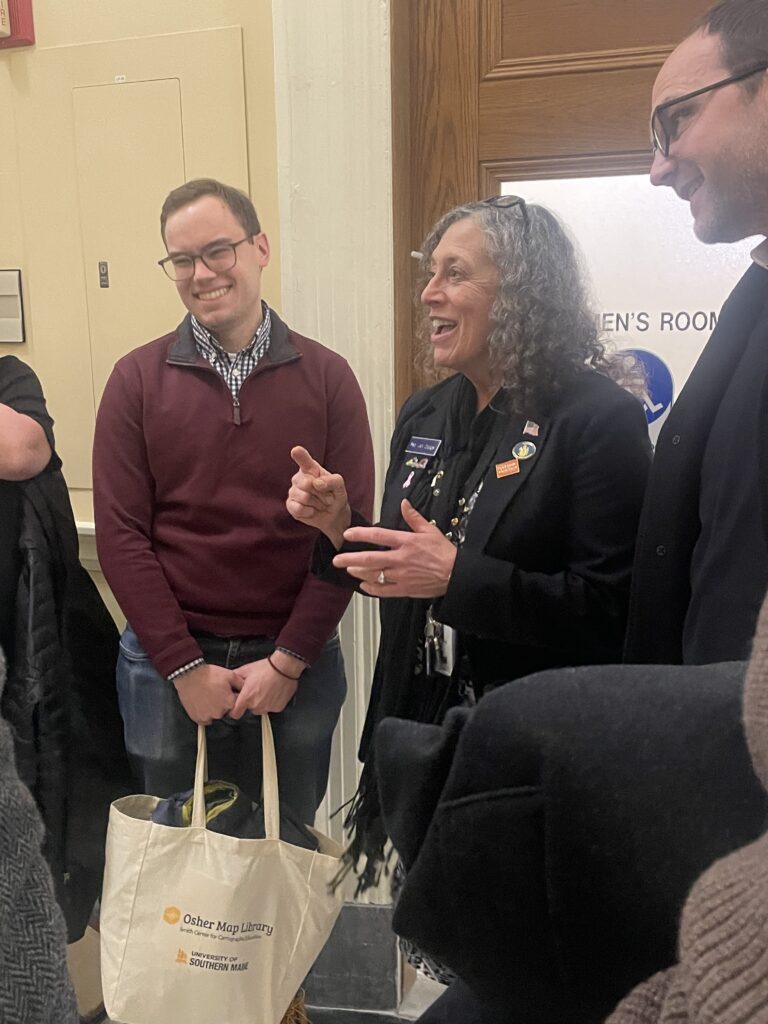
Representative Jan Dodge spent her decades-long career as a music educator involved in MEA’s advocacy work through MEA Lobby Days at the State House, serving on the Government Relations Committee, and as a leader in her local association.
After retiring, she moved back to her hometown of Belfast and quickly became a familiar advocate and leader through the Waldo County Retired Teachers group, Aging Well Waldo County, and the chamber of commerce. So, it is no surprise that when an open seat emerged in the Maine House of Representatives, neighbors encouraged her to run.
Dodge admits the decision to run didn’t come easily. “I had moments of self-doubt. It wasn’t something I had planned to do,” she reflects. “I prayed about it, and within two weeks I had people step up to be a campaign manager and a treasurer. That’s when I realized this was what I was supposed to do.”
“I’ve introduced bills—some don’t pass—but the discussion brings a new perspective to the table. People ask questions and you can reveal the ‘behind the scenes’ of how schools really work.”
Jan Dodge
State Representative
→Bringing a Classroom Perspective to Policymaking
Now in her fourth term serving in the Maine House, Dodge says running gave her the chance to bring the voice of an educator to policy conversations—a perspective often missing in Augusta. She has spent nearly eight years doing just that.
“I’ve introduced bills—some don’t pass—but the discussion brings a new perspective to the table,” Dodge says. “People ask questions and you can reveal the ‘behind the scenes’ of how schools really work.”
One example is a bill she introduced to guarantee students at least 30 minutes for lunch. While the proposal didn’t pass, Dodge says it sparked important conversations about school policies, in this case a conversation about how scheduling impacts nutrition and equity in schools.
“If you haven’t served lunch duty or been the last in the line for lunch in the school cafeteria, you don’t realize how little time kids have,” Dodge says. But for her, this bill wasn’t only about time, it also aimed to reduce food waste and address hunger. When students have more time to eat, they consume more of their meal, waste less food, and return to class, better prepared to learn.
“Even though the bill ultimately didn’t become law, I am proud to say that it sparked important conversations about how scheduling impacts nutrition, and food waste in schools,” she explains.
Dodge said over the course of her four terms, she is most proud of the breadth of her committee work. “I introduced legislation that was heard in front of nearly every committee—bills that impact retirees, schools, educators, labor, but also bills that impact the environment or energy policy,” she reflects. Her approach to service in the House is much like her teaching, show up, listen, learn, and have a broad influence.
→Educators Make Great Representatives
Before running for State Representative, Dodge had not run for office before. Like many first-time candidates, she discovered how much there is to learn at the State House but says that it shouldn’t stop anyone. “The amount of learning is huge. But that shouldn’t be a deterrent. Educators are used to learning fast, adapting, and juggling a lot—those skills translate.”
According to Dodge, there are many practical skills and parallels between teaching and serving in the legislature. “In the legislature you work with all different personalities, you must follow rules and procedures, eat lunch on the fly, and balance multiple priorities. These are all things we do as educators every day.”
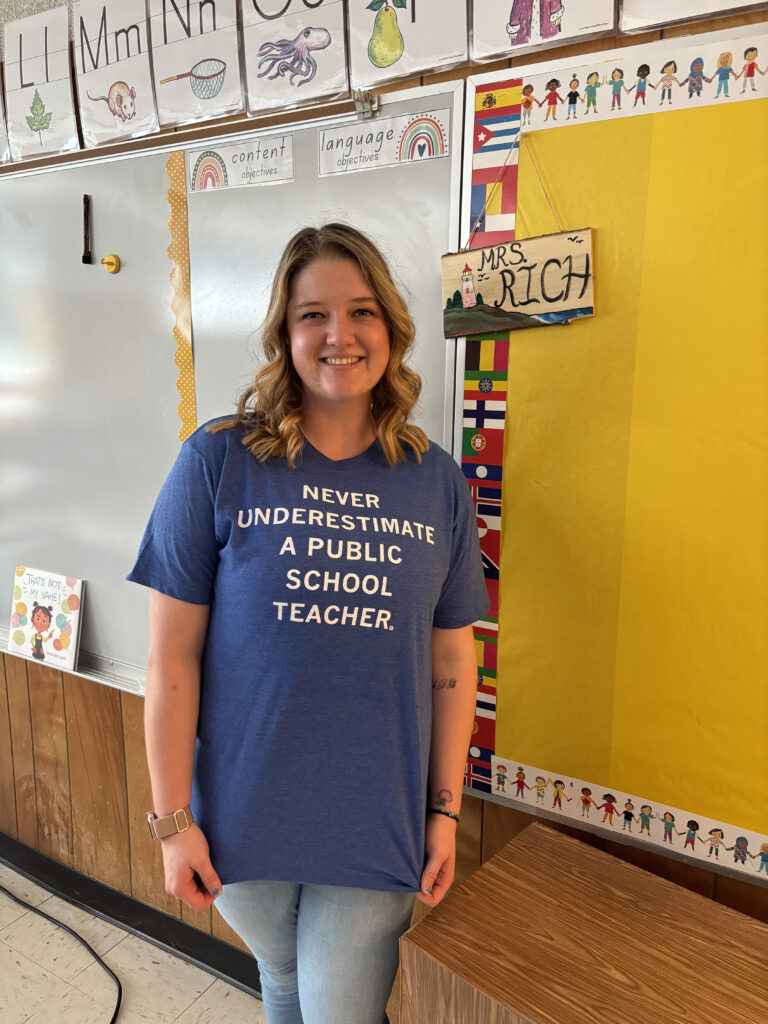
“We know education better than anyone else on a board. Why wouldn’t we want an expert in the field? It’s better for contracts, better for policy, better for students.”
Jaye Rich
Auburn School Committee
→Bringing Educator Voices to Local Leadership
Those same skills matter just as much at the local level. Each year, hundreds of positions on local school boards and school committees are up for election. Like statewide offices, these roles are critical for shaping education policy and the working and learning conditions of our colleagues and students—and they offer a valuable opportunity for both active and retired educators to serve.
For Jaye Rich, a multilingual teacher in Lewiston, stepping up to run was about representation, and reality. “I think it’s important to have educators on a school board, especially someone who worked through COVID and after COVID,” she said. “Education has changed since then, and I wanted our educators to feel like they had a voice.”
→Shaping Decisions That Matter
Since being elected to the Auburn School Committee, Rich says she is proud of how she and her colleagues continue to operate in a respectful and collaborative way, and the role she plays in bringing an educator’s perspective to decisions, especially during contract negotiations.
“We know education better than anyone else on a board, she says. “Why wouldn’t we want an expert in the field? It’s better for contracts, better for policy, better for students.”
Rich isn’t alone in believing educators make a difference. Soifer, serving on the RSU 18 School Board, shares that perspective. For him, serving on the board is a way to move beyond advocacy and create direct change.
“Being on the school board was a more direct way to work toward something I care deeply about. Education for children,” he said. “We [the RSU 18 School Board] have started to turn things in a better direction. We have a new superintendent, which is very positive. And I’ve worked to help elect people who will bring fresh perspectives.”
→Running for Office Can be Fun!
Rich leaned on local leaders for guidance, including former Auburn mayor and MEA connections, as she learned the ropes of fundraising and endorsements. Then came the hardest—and most rewarding—part, meeting voters face-to-face.
“The most intimidating part is knocking doors,” Rich says. “But it’s the most rewarding. You have great conversations, and it’s a good opportunity to find a way to disagree respectfully.” Those conversations helped Rich connect with neighbors and learn what they wanted for their schools.
Dodge says she found these conversations rewarding as well. Throughout her four campaigns, she made it a priority to talk to as many constituents as possible and to stay accessible to them while serving in the Maine House. That effort did not go unnoticed. After her first term, constituents and neighbors made a point to share how much they appreciated her hard work, responsiveness to emails, and persistence.
→Just Do It!
Whether at the local or state level, MEA members are helping to shape policy and strengthening schools. They want others to join them. “Start asking questions now. Talk to your union leaders,” Rich suggests. “Reach out to me—I’d love to talk to people about running.”
Serving in public office may seem intimidating, but those who have done it say educators already have the skills to succeed. They bring expertise no one else can offer, and that perspective strengthens decisions on everything from contracts to curriculum.
No matter where you choose to serve—on a school board, in the state legislature, or beyond—your voice leaves a lasting impact, and it may surprise you how much you love the experience.
Dodge reflects on her eight years in office, saying she enjoyed being a legislator as much as teaching. For her, the privilege of voting never loses its power.
“When a bill comes to the floor and I reach out and push my button to make my vote, I know that I am giving my constituents and educators in Maine a voice,” she reflects. “And I always get goosebumps because in that moment, I have the privilege of using my voice to make a difference.”

→How MEA’s Endorsement Process Works
Why do we endorse candidates?
MEA brings together members to screen candidates who support us and advocate for pro-education policies that support our schools, our students, and our professions. Endorsing and electing candidates who support MEA’s goals increases the Union’s ability to pass legislation that benefits our students and schools.
Who Decides?
The Screening and Endorsement team is made up entirely of MEA members consisting of MEA Officers, MEA Board of Directors, MEA Government Relations Committee, Local Association Presidents or their designees, and MEA Representative Assembly (RA) delegates.
What are the issues?
MEA Members determine MEA policy priorities through member-led proposals and discussions. Screening and Endorsement questionnaires are created based on issues identified by MEA RA delegates, MEA Officers, Board of Directors, and Government Relations Committee members.
→The Process
MEA prides itself on having a clear, fair, and democratic process leading up to the endorsement of a candidate.
Step 1
Following the June Primary, questionnaires on public education issues are sent out to candidates. All questionnaires must be filled out by the candidate and returned to MEA by the deadline to be considered for the Screening and Endorsement process.
Step 2
The Screening and Endorsement team meets in July to evaluate the questionnaires. MEA members on the Screening and Endorsement team lead discussions to determine which candidates align with MEA policy priorities and propose candidates for MEA’s collective endorsement.
Step 3
The Screening and Endorsement team sends endorsement recommendations for candidates to the MEA Board of Directors who make the final decision on endorsements by the Union.
→Should You Run for Public Office?
YES, YOU SHOULD!
As an educator and union member, you’ve shown your commitment to doing everything you can to improve outcomes for your students. But imagine your potential impact as an elected official, where you could leverage your passion, experience, and insights to improve public education on a larger scale.
If you think running for office at any level is something you are interested in, reach out to MEA’s Government Relations Director, Jan Kosinski.
